
Coffee is about 98% water. It is the only ingredient in the cup that nobody weighs, nobody records and, in most roasteries and cafés, nobody actually knows the composition of. Two waters that read the same on a TDS meter can turn the same lot into two different coffees — one bright and layered, the other flat and hollow. This is what mineralization means in practice, and what to do about it.
Two waters can read the same on a meter and turn the same lot into two different coffees.
Three numbers, and why they get confused
Almost every argument about water for coffee comes from mixing up three separate things:
- TDS, total dissolved solids. Everything dissolved in the water, added together, in mg/L. It is a sum, not a description: it says how much, never what.
- Total hardness. The calcium and magnesium content, conventionally expressed as mg/L of CaCO3. This is the part that extracts.
- Alkalinity. Mostly bicarbonate, also as mg/L of CaCO3. This is the part that buffers: it neutralizes the acids your coffee worked so hard to develop.
Hardness and alkalinity are both counted inside TDS, but they pull the cup in opposite directions. That is the whole reason TDS on its own predicts nothing.
Unit conversions worth memorizing
- 1 grain per gallon (gpg) = 17.1 mg/L as CaCO3
- 1 German degree (°dH) = 17.8 mg/L as CaCO3
- 1 mEq/L = 50 mg/L as CaCO3
- 1 mmol/L of bicarbonate = 50 mg/L alkalinity as CaCO3
- 1 mg/L = 1 ppm, near enough, in fresh water
What hardness does
Magnesium and calcium ions bind to the flavour compounds in coffee and carry them into the water. More hardness means more extraction at the same recipe, which is why a soft water and a hard water need different grind settings for the same coffee.
The two ions are not interchangeable. Magnesium tends to pull brightness, fruit and acidity forward; calcium leans towards body, sweetness and a rounder, heavier cup. Neither is correct in the abstract: a delicate washed Colombian and a heavy natural want different water, and that is a legitimate lever to pull rather than a problem to solve.
What alkalinity does
Bicarbonate neutralizes acids. Low alkalinity leaves acidity sharp and unbuffered, sometimes electric and alive, sometimes aggressive and sour. High alkalinity flattens the cup: the malic and citric notes you paid a premium for get chemically muted, and what is left reads as dull, papery or vaguely salty.
This is where most disappointing cups come from. A roaster tastes a lot at origin, buys it, brews it at home on municipal water with 120 mg/L of alkalinity, then quietly concludes the sample was better than the shipment. The coffee did not change. The buffer did.
Why a TDS meter misleads you
A TDS meter does not measure dissolved solids. It measures electrical conductivity and multiplies it by a fixed factor. It cannot distinguish calcium from magnesium from bicarbonate from sodium, and sodium, which does nothing good for coffee, raises the reading just as happily as magnesium does.
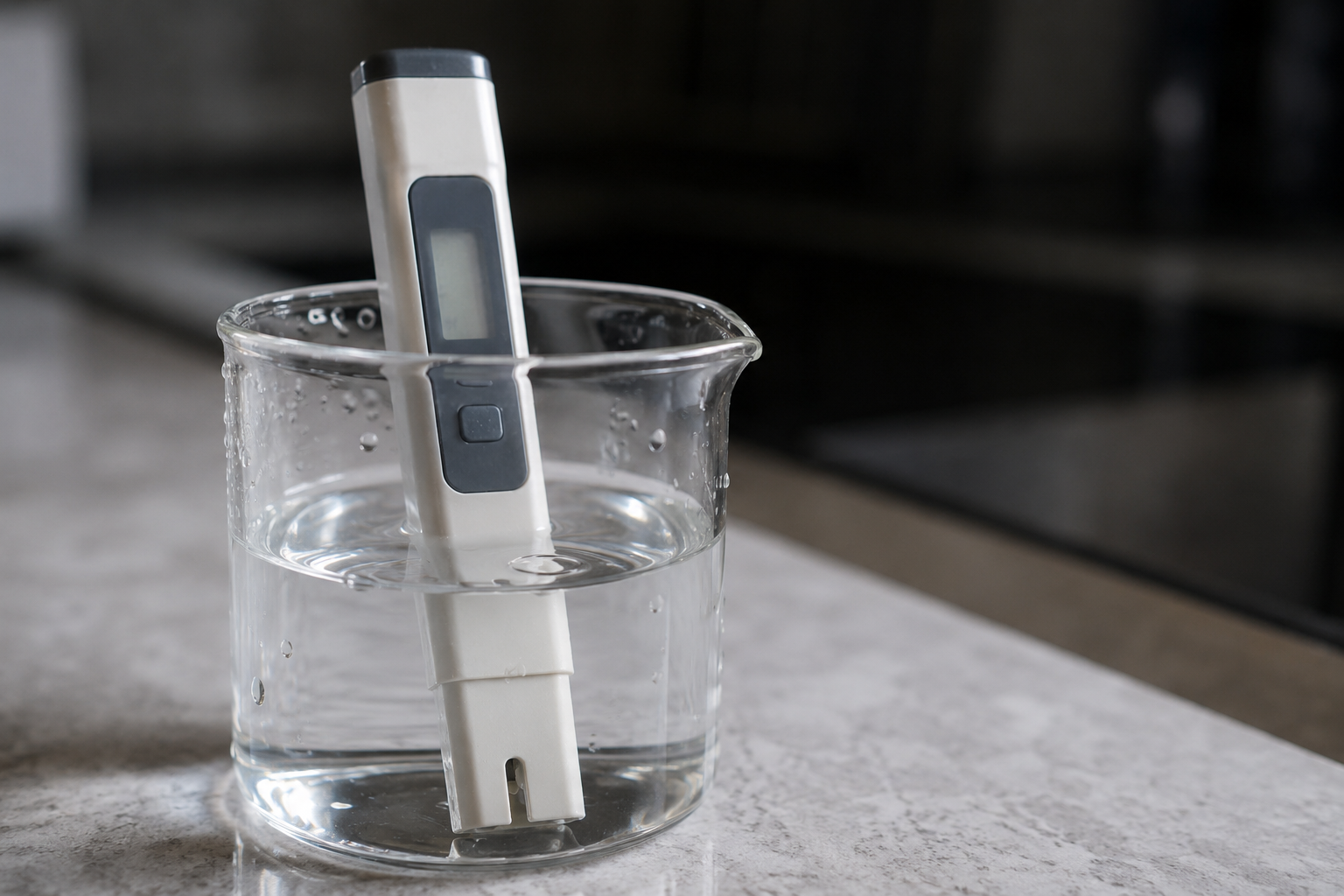
A TDS meter measures conductivity and multiplies by a fixed factor. It never says what is in the water.
So 150 mg/L can be a well-balanced brewing water, or it can be almost pure bicarbonate that will flatten everything you put through it. Use the meter for what it is good at: noticing that something changed. To know what is in the water, use a drop test kit for hardness and alkalinity, or ask your utility for an analysis. Most utilities publish one, and most of it moves with the season.
The SCA reference values
The long-standing SCA reference figures for brewing water are a sensible place to start. The standard has been revised in recent years, so check the current published edition before quoting it in a specification, but the targets have stayed close to these:
- TDS: target 150 mg/L, acceptable 75–250 mg/L
- Total hardness as CaCO3: target 68 mg/L (4 gpg), acceptable 17–85 mg/L (1–5 gpg)
- Total alkalinity as CaCO3: target 40 mg/L, and the acceptable band is narrow, at or near 40
- pH: target 7.0, acceptable 6.5–7.5
- Sodium: at or near 10 mg/L
- Total chlorine: 0 mg/L, with no room to negotiate
- Odour and colour: clean, fresh, clear
Note what those numbers imply: hardness roughly one and a half to two times alkalinity. That ratio matters more than either figure on its own.
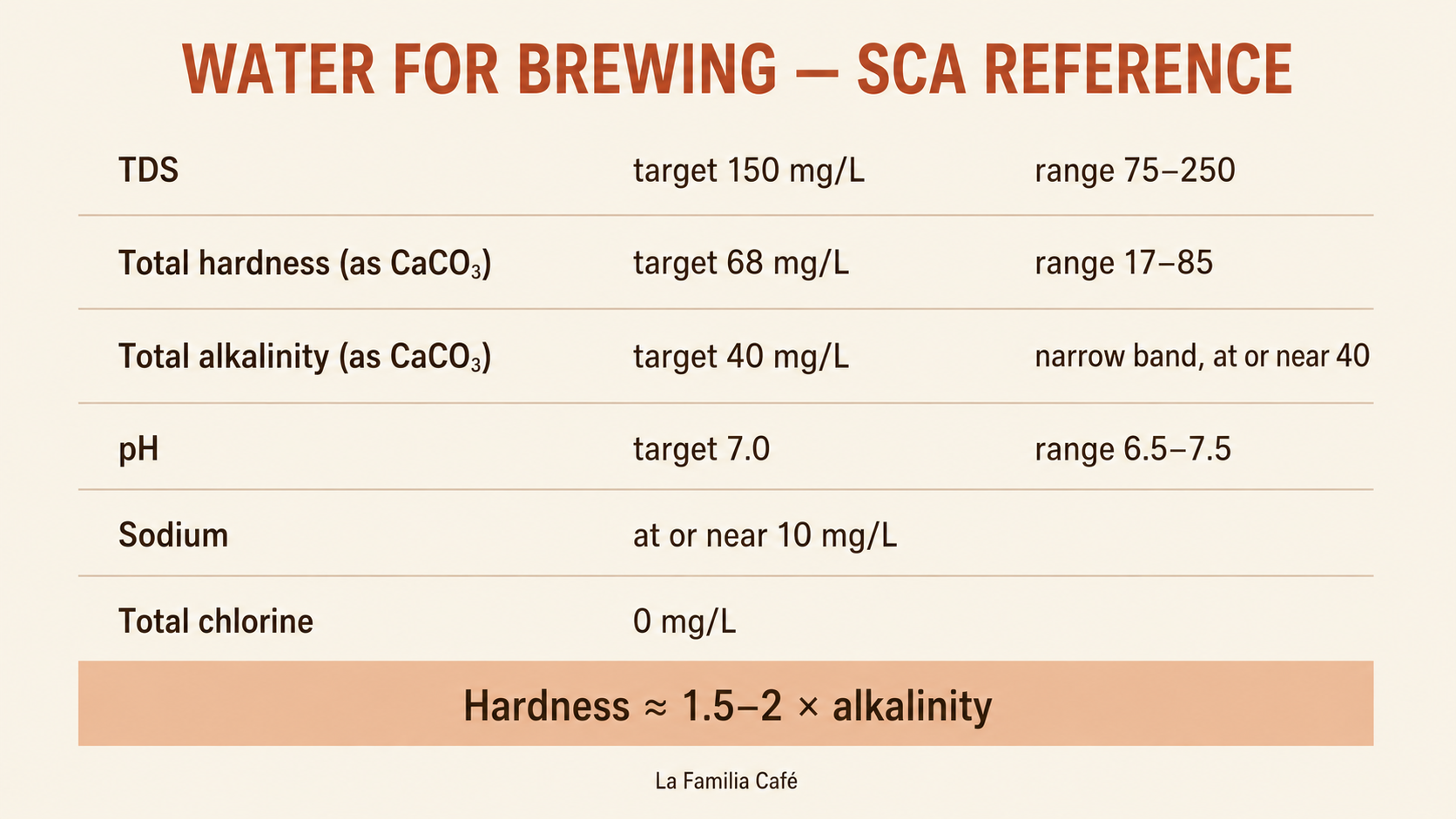
SCA reference values for brewing water. Check the current published edition before quoting them in a specification.
Water for cupping is a different job
When you brew for pleasure, water is a tool for shaping a cup. When you cup, water is a control variable, and the only thing that matters is that it never moves.
The cupping protocol asks for clean, odour-free water, free of chlorine, at 125–175 mg/L TDS, brought to 93 °C. Beyond the numbers, three rules decide whether your session means anything:
- One water for the whole table. Different water between samples makes the comparison worthless, which is the entire point of cupping.
- The same water between sessions, if you intend to compare today's scores against last month's.
- Write the water down: hardness, alkalinity, source. A score without its water is an opinion; a score with its water is data.
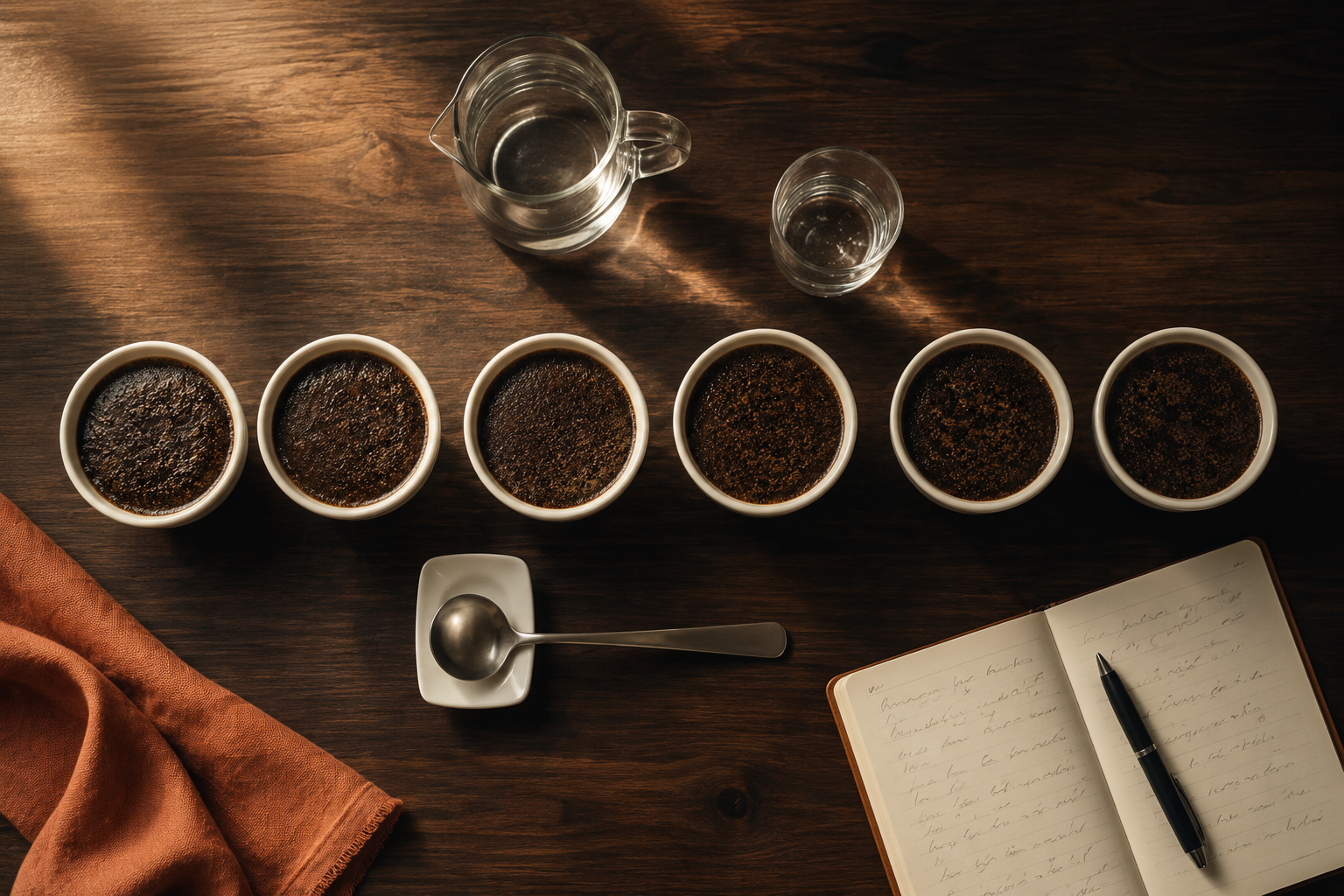
A score without its water is an opinion; a score with its water is data.
Our own free cupping calculator has a note field on every session for exactly this. It costs five seconds, and it is the difference between a disagreement you can settle and one you cannot.
A water recipe you can weigh
The reliable way to control water is to start from nothing and add what you want: distilled or reverse-osmosis water plus weighed salts. You need a scale that reads 0.01 g.
A balanced starting point, per 1 litre of distilled water:
- 0.10 g magnesium sulfate heptahydrate, sold as Epsom salt, giving about 40 mg/L hardness as CaCO3
- 0.07 g sodium bicarbonate, ordinary baking soda, giving about 40 mg/L alkalinity as CaCO3
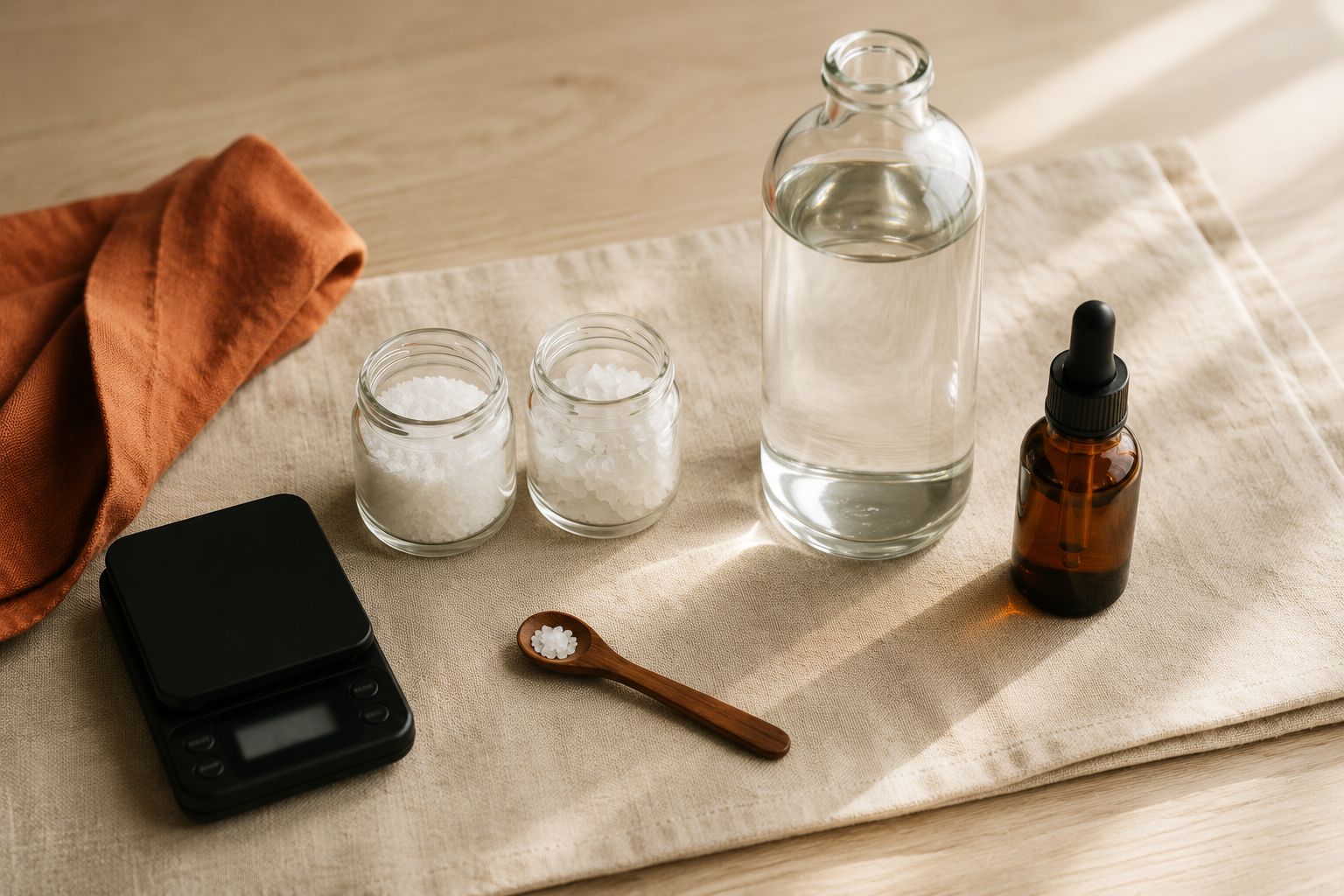
Distilled water plus two weighed salts: the only way to know what you are brewing with.
That lands near 120 mg/L TDS, inside the SCA range, with hardness and alkalinity balanced. From there, move one variable at a time: more magnesium sulfate for brightness and extraction, more bicarbonate if the cup is harsh and needs rounding off, less bicarbonate if it tastes dull.
Weighing hundredths of a gram every morning is miserable, so make a concentrate: 10 g Epsom salt and 7 g baking soda dissolved in 1 litre of distilled water, then 10 ml of that concentrate per litre of brewing water. Keep it refrigerated, label it, remake it monthly.
Use food or laboratory grade salts, never garden or bath products with additives. And know your equipment: alkalinity much above 50 mg/L starts building scale in a boiler, while fully demineralized water is aggressive towards metal and should never go into a machine undosed.
Troubleshooting: what you taste, what to change
- Flat, dull, papery, acidity gone. Alkalinity too high. Cut the bicarbonate, or dilute with distilled water.
- Sharp, sour, aggressive. Alkalinity too low. Add bicarbonate in small steps.
- Thin, hollow, watery. Hardness and TDS too low. Add magnesium sulfate.
- Chalky, drying, bitter finish. Hardness too high, often calcium-heavy. Reduce it.
- Salty or metallic edge. Sodium too high. Stop using ion-exchange softened water for brewing: it trades calcium for sodium.
- Chlorine or swimming-pool note. Residual chlorine or chloramine. Carbon filtration, and chloramine needs real contact time.
- Scale in the boiler. Alkalinity and hardness both high. Treat the feed water, not the symptom.
Six things the industry keeps repeating that are wrong
- "Distilled water is the purest, so it must be best." Pure water extracts poorly, tastes hollow and attacks equipment. It is a blank canvas, not a finished water.
- "Bottled water is safe." Bottled waters run from near-distilled to over 400 mg/L of bicarbonate. Read the label every time the brand changes.
- "Harder water means more body." Up to a point. Past it you get chalk and astringency, and a heavier mouthfeel is not the same thing as a better cup.
- "My meter says 150, so my water is fine." It says the conductivity is consistent with 150. It says nothing about the balance that actually shapes flavour.
- "The filter handles it." Most cartridges reduce chlorine and hardness while leaving alkalinity largely intact, which often makes the imbalance worse rather than better.
- "Water only matters at the café." It matters wherever anyone decides what a coffee is worth: at the mill, at the exporter's lab, at the importer's table.
Why an exporter cares about your tap
We cup every lot before it leaves, and our buyers cup it again when it lands. When the two scores disagree by a point and a half, the conversation that follows is expensive, and in our experience it is more often about water than about coffee. Alkalinity is the usual culprit: the same lot, buffered differently, honestly tastes like a different coffee.
The same lot, buffered differently, honestly tastes like a different coffee.
So we log the water with every session, and we ask our partners to do the same. It turns a vague dispute into a two-minute comparison, and it protects the producer whose work is being judged.
If you want to test the idea on real coffee, our current lots are in the catalogue, and the calculator is free to use. Questions, corrections and your own water numbers are genuinely welcome at sales@lafamiliacafe.co — put "Water" in the subject line.