
Coffee has always been judged by a human tongue. That is not changing — but what happens before the cup reaches a cupper's table is changing fast, and it is worth talking about.
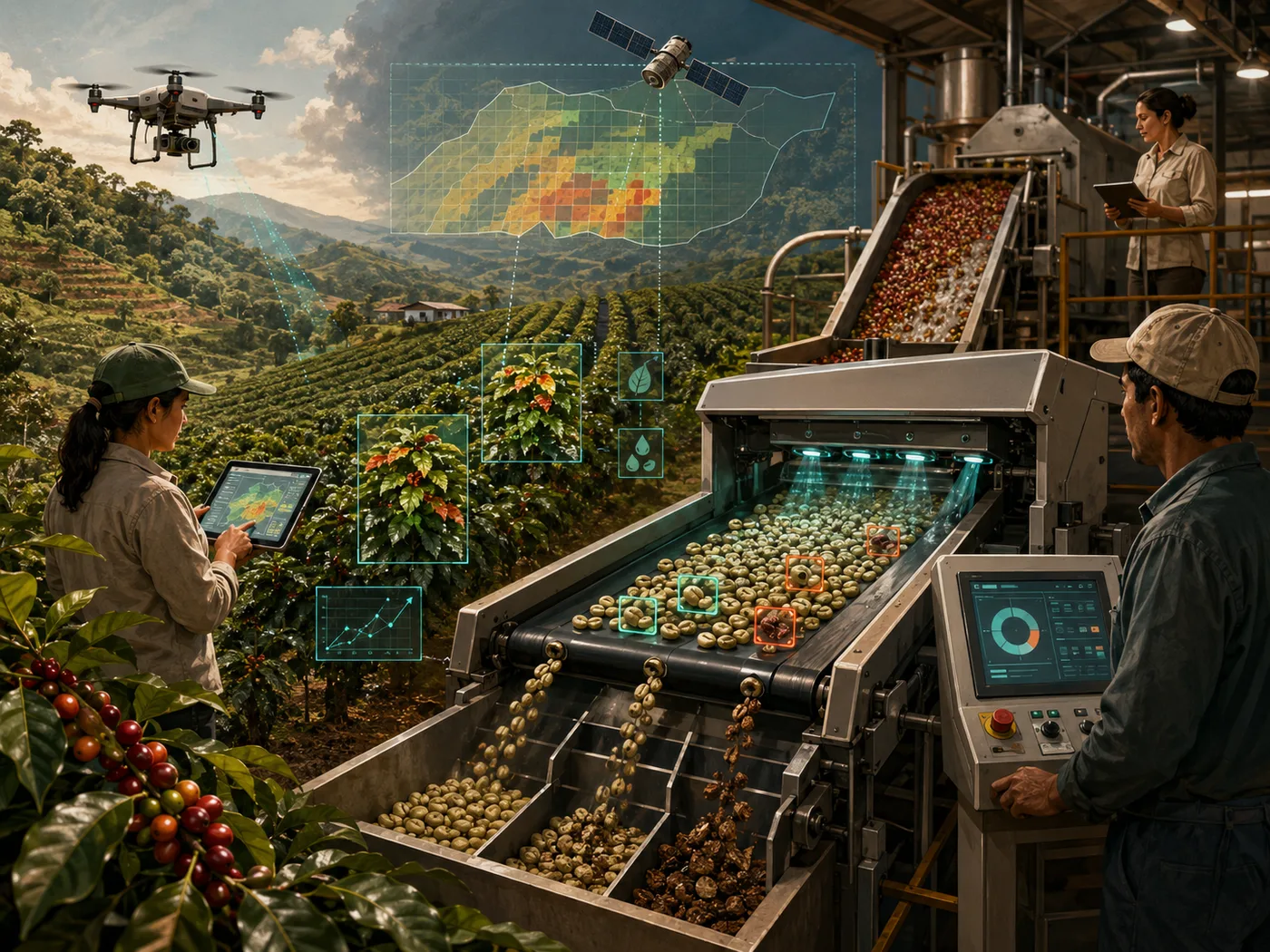
On the farm, the first shift is invisible from the ground. Satellite and drone imagery, combined with machine learning models, now let agronomists spot leaf rust or nutrient stress in a plot of trees weeks before it is visible to the naked eye. For a smallholder in a remote region, that early warning can be the difference between a normal harvest and a devastating one. Yield-prediction models are also getting good enough that exporters can plan logistics and pricing months ahead instead of guessing at cherry counts in the field.
At the mill, computer vision has replaced a lot of manual sorting. Optical sorters trained on thousands of images of defective beans — insect damage, black beans, quakers — now catch what a tired pair of human eyes might miss on hour six of a shift. This does not remove the need for skilled sorters; it changes their job from repetitive scanning to quality supervision, which is arguably better work.
Roasting is where the technology gets the most attention, and for good reason. Profile-optimization software can now analyze thousands of past roasts against cupping scores and suggest adjustments to charge temperature, development time, or airflow to hit a target flavor profile more consistently. Small roasteries that could never afford a dedicated R&D team suddenly have a tool that behaves like one. It does not invent flavor — it helps a roaster reproduce their best batch instead of chasing it.
Cupping itself is the most contested frontier. There are now models that attempt to predict a cupping score from spectral or chemical analysis of green beans, before a single cup is brewed. The results are promising for triage — flagging lots worth a closer look, or ones probably not worth shipping — but no serious buyer signs a contract based on a machine's number alone. The SCA form exists because flavor is relational: sweetness reads differently against a specific acidity, body changes how aftertaste lingers. That kind of judgment, built from years of comparing hundreds of cups side by side, is not something a model has yet learned to do honestly.
What strikes me most, working alongside these tools, is that they are best understood as instruments, not judges — closer to a refractometer than to a Q-grader. They narrow the field, catch fatigue-driven mistakes, and free up human attention for the part of the process that actually needs it: tasting carefully, comparing honestly, and deciding what a coffee is actually worth. The romantic image of a lone cupper with a spoon and a notebook is not going anywhere. It is just getting better instruments to work with.